
New to Krav Maga or martial arts in Brisbane?
Most people who book their first class at Champions Krav Maga Academy are new to Krav Maga and have never trained before. They are not particularly fit. They are not sure they are ready. And most of them have been sitting on the decision longer than they want to admit.
That uncertainty is completely normal when you are new to martial arts.
Whether you are an adult looking to build real self-defence skills, or a parent exploring training for your child or teen, choose the tab below that fits you and find the information that is right for you.
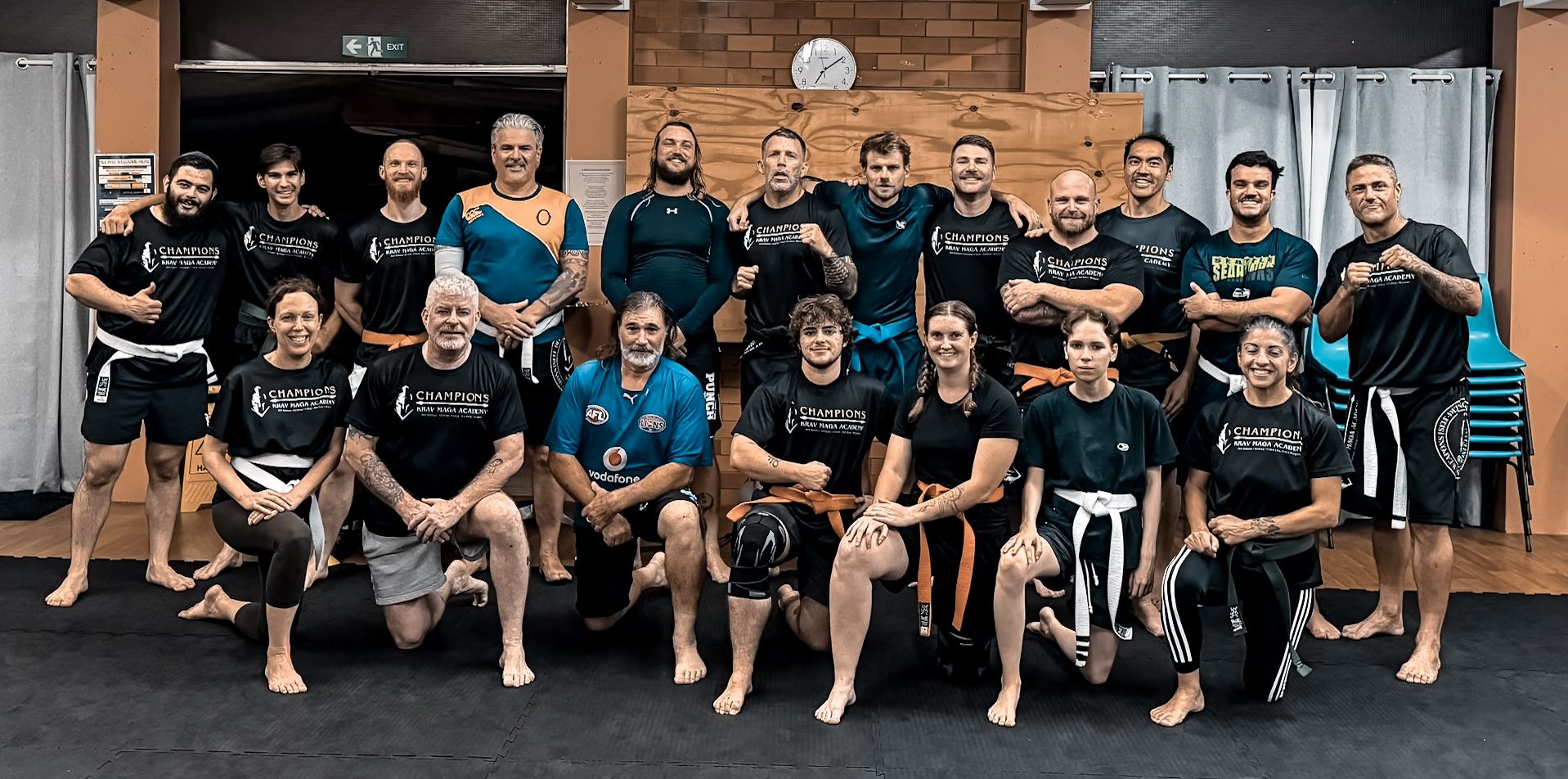
What is Krav Maga, and why do adults start here?
Most adults who find CKMA are not searching for a hobby. They are searching for an answer to a question they have been carrying for a while.
It usually sounds something like this. If something happened right now, would I know what to do? Would I stay calm? Or would I freeze?
Krav Maga is the training that answers that question. It is a practical self-defence system built for real people in real situations. Not for athletes. Not for competitors. For everyday adults who want to be calm, capable, and in control when it matters.
The techniques are direct and built on natural body reactions. The principles are designed to work under stress, not just in a controlled training environment. Because it is principle-based, you learn not just what to do but why, which means you can adapt when a situation does not follow a script.
If you want to understand the full history and purpose of the system before you book, read our guide: What is Krav Maga? History, purpose and beginner guide.
Who this section is for
This section is written for adults who are new to Krav Maga, self-defence, or martial arts in Brisbane and are figuring out whether CKMA is the right fit before they commit to anything.
You might recognise yourself here
You have been thinking about learning self-defence for a while but you are not sure what kind of training is right for you. You want something practical and structured, not sport-focused or intimidating. You are not confident you are fit enough or coordinated enough to start. You have wondered whether you will be completely out of your depth in that first class, or whether the room will be full of people who already know exactly what they are doing.
Those concerns are common for anyone new to martial arts. They are also not a reason to wait.
Elvis started at CKMA with exactly that hesitation. Before training, he worried about being overwhelmed by aggression. That shift did not come from confidence he already had. It came from showing up.
If you have prior experience in Krav Maga, boxing, Muay Thai, jiu-jitsu, or another system, visit our previous experience page instead. It covers how to find the right entry point based on your background.
What you will learn when you are new to Krav Maga
Krav Maga for beginners at CKMA is practical and progressive. You do not start with advanced techniques. You start with skills that are genuinely useful, that build on each other in a logical order, and that give you something real from the very first session.

Stance, movement, and creating space
Good movement is the foundation of everything in self-defence. Beginners first learn how to stand, move, and create distance from a threat. This keeps you balanced, reduces your exposure, and helps your brain stay online when a situation escalates. Most people are surprised by how much control a small shift in positioning actually gives them.

Situational awareness and early threat recognition
Self-defence starts well before any physical contact. Beginners learn to read environments, body language, distance, and exits. The goal is to recognise problems earlier and make better decisions before a situation becomes physical. This is one of the most transferable skills you will build and it starts showing up in everyday life within the first few weeks of training.

Basic strikes and defensive reactions
Beginners learn direct, practical striking and defensive movements built around natural body reactions. They are easier to learn, easier to retain under pressure, and more likely to work in a real situation than complex techniques that require perfect form. The focus is not on looking like a fighter. It is on building responses that actually function when your body is under stress.

Escaping common grabs and holds
Beginners learn how to respond to common holds and grabs calmly and effectively. The emphasis is not on executing a flawless technique. It is on staying composed, protecting yourself, creating space, and moving towards safety. These responses build the kind of calm under pressure that carries well beyond the training mat.

Awareness, positioning, and the principles behind the techniques
Krav Maga is principle-based, which is what makes it different from systems that rely on memorising fixed sequences. Beginners learn the reasoning behind each skill, not just the movement itself. That understanding is what allows you to adapt when a real situation does not unfold the way a training drill did.
What to expect in your first class at CKMA
Your first class is designed to feel simple and clear, even if you are brand new to Krav Maga. You do not need to know the movements, the terminology, or the class structure before you walk in. We take care of all of that.
Before you arrive
After you book your free intro class, we confirm the time and help you understand what to wear, what to bring, and where to go. Comfortable training clothes and a water bottle are all you need. We handle everything else.
When you walk in
One of the CKMA team will meet you at the door, help you get oriented, and make sure any waivers or forms are completed before class starts. Where possible, we pair new students with a more experienced training partner so you are not left to figure things out alone in an unfamiliar environment.
During class
Your first class starts on time and follows a clear structure. The instructor teaches step by step. You train in a controlled, supported way. You can ask questions, take your time, and make mistakes without any pressure to perform.
Before you leave
At the end of your first class, the instructor closes the session and the group greets out together. Before you go, we help you understand the right next step. Whether that is our Adult Beginner Krav Maga program, our Women’s Krav Maga classes, or another pathway based on your goals, you leave with a clear picture of what comes next.
Why adults new to Krav Maga choose CKMA
There are good martial arts options across Brisbane. Here is what makes CKMA different for adults who are new to martial arts.
Practical self-defence from session one
Adult beginner training at CKMA starts with Krav Maga. You build real self-defence capability from the very first class, not after months of drills that feel disconnected from anything useful in the real world.
An integrated system with a clear long-term pathway
As you progress, training expands into broader martial arts development through the Gendai Ryu Krav Maga and Jiu-Jitsu system, affiliated with Dr Gavriel Schneider and the Federation of Israeli Martial Arts (FIMA). This draws on boxing, Muay Thai, jiu-jitsu, judo, wrestling, and MMA-based training. You start with a clear purpose and keep building from there.
Structured training, not random techniques
CKMA runs a rotating curriculum. Every class connects to a broader learning pathway. You revisit and refine key areas while steadily developing new skills across striking, clinch, ground work, and weapons awareness.
A culture with no ego and no intimidation
CKMA is built around four values: Service, Growth, Community, and Safety. People new to martial arts are not treated as inconveniences. There is no pressure to perform before you are ready. You train hard, you train safely, and you are supported from the first session to the last.
Clear membership with no lock-in contracts
When you are ready to join, we make it straightforward. No joining fees. No lock-in contracts. Simple weekly payments so you are never committed to something that is not working for you.
Which adult class should you start with?
Adult Beginner Krav Maga
The right starting point if you want practical self-defence in a structured environment with other beginners, clear coaching, and a program designed specifically for people new to Krav Maga.
Women's Krav Maga
For women who prefer a women-only starting point. These classes focus on practical self-defence, awareness, and personal safety in a comfortable, female-only environment.
FAQ: adults new to Krav Maga
Is Krav Maga suitable for complete beginners?
Yes. Our Adult Beginner Krav Maga program is built specifically for people with no prior experience. If you are new to Krav Maga, you learn step by step with clear, patient coaching from your first class. No background in martial arts is required or expected.
Do I need to be fit before I start?
No. You start at your current level. Training is how you build fitness, coordination, and confidence over time. Waiting until you are fitter is one of the most common ways people delay the decision indefinitely. You do not need to earn your place here before you arrive.
Will I be thrown into hard sparring?
No. Krav Maga for beginners at CKMA is controlled and progressive. You build technique, confidence, and control well before any contact-based training is introduced.
What should I wear to my first class?
Comfortable training clothes that allow you to move freely. Bring a water bottle. We will confirm any other details when you book your free intro class.
You can do this. The first step is free.
No experience needed. No fitness threshold to meet. Just a clear first step.
What is Krav Maga, and why do parents choose it for their children?
Most parents who find CKMA are not looking for a martial arts class. They are looking for an answer to something they have been watching for a while.
It usually sounds like this. If something happened at school, on the bus, or in a situation I was not there for, would my child know what to do? Would they hold their ground? Or would they freeze?
Krav Maga is the training that starts to build that answer. For kids and teens, the youth programs at CKMA adapt the principles of practical self-defence into age-appropriate training that builds real capability alongside the confidence, discipline, and grounded character that parents actually care about.
This is not training designed to produce aggression. The goal is the opposite. A child who trains here learns awareness, calm decision-making, and how to handle difficult situations before they become physical. The confidence that develops is quiet and real, not performative.
Most parents also notice something they did not expect. The change does not stay on the mat. It shows up at home, at school, and in the small daily moments they have been watching and waiting for.
For a deeper look at why the system works well for younger students, read our guide: 7 practical reasons to choose Krav Maga for kids in Brisbane.
Who this section is for
This section is written for parents who are new to martial arts and are considering CKMA for their child or teenager.
You might recognise yourself here
Your child lacks confidence in social situations or struggles to hold their ground when pressure comes from peers. Your teenager is starting to move more independently and you want to know they can make smart decisions when you are not there. You are looking for an activity that builds something lasting in your child, not just fills an afternoon. You have tried other activities that did not stick and you are wondering whether this will be different.
If any of that sounds right, this section is for you.
What your child will learn
Youth training at CKMA is structured, age-appropriate, and built to develop real capability over time, even for children who are new to martial arts. Here is what both programs focus on.

Awareness and recognising unsafe situations early
Kids and teens learn to read environments, recognise warning signs, and understand distance and positioning before a situation becomes physical. This is often the skill parents notice transferring into everyday life first. A child who starts paying attention to their surroundings, thinking ahead, and trusting their instincts is already safer than one who reacts only after contact happens.
Boundary setting and confident communication
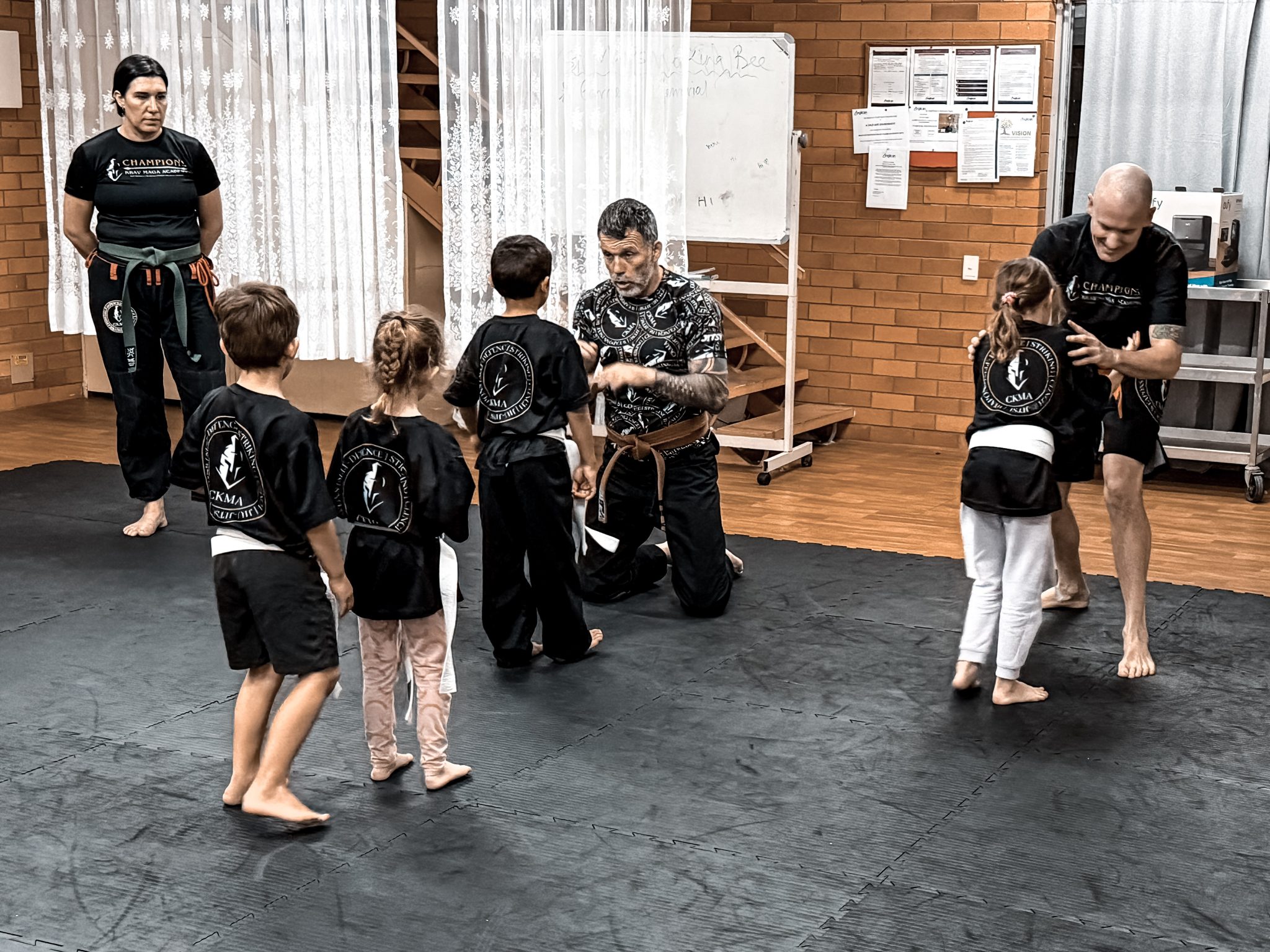
Before any physical technique is taught, young students learn to hold their ground verbally and with confidence. They practise saying no clearly, setting boundaries under social pressure, and projecting calm authority without aggression. Parents regularly find this is the skill that shows up most visibly at school, at home, and in social situations within the first few weeks.

Age-appropriate self-protection techniques
Both programs teach practical self-protection responses scaled to the age, size, and development of the student. For kids aged 6 to 10, the focus is on basic awareness, body mechanics, and simple protective responses. For teens aged 11 to 17, training progresses into more applied self-defence, striking fundamentals, grappling basics, and situational decision-making.
Discipline, focus, and the habits of a respectful student
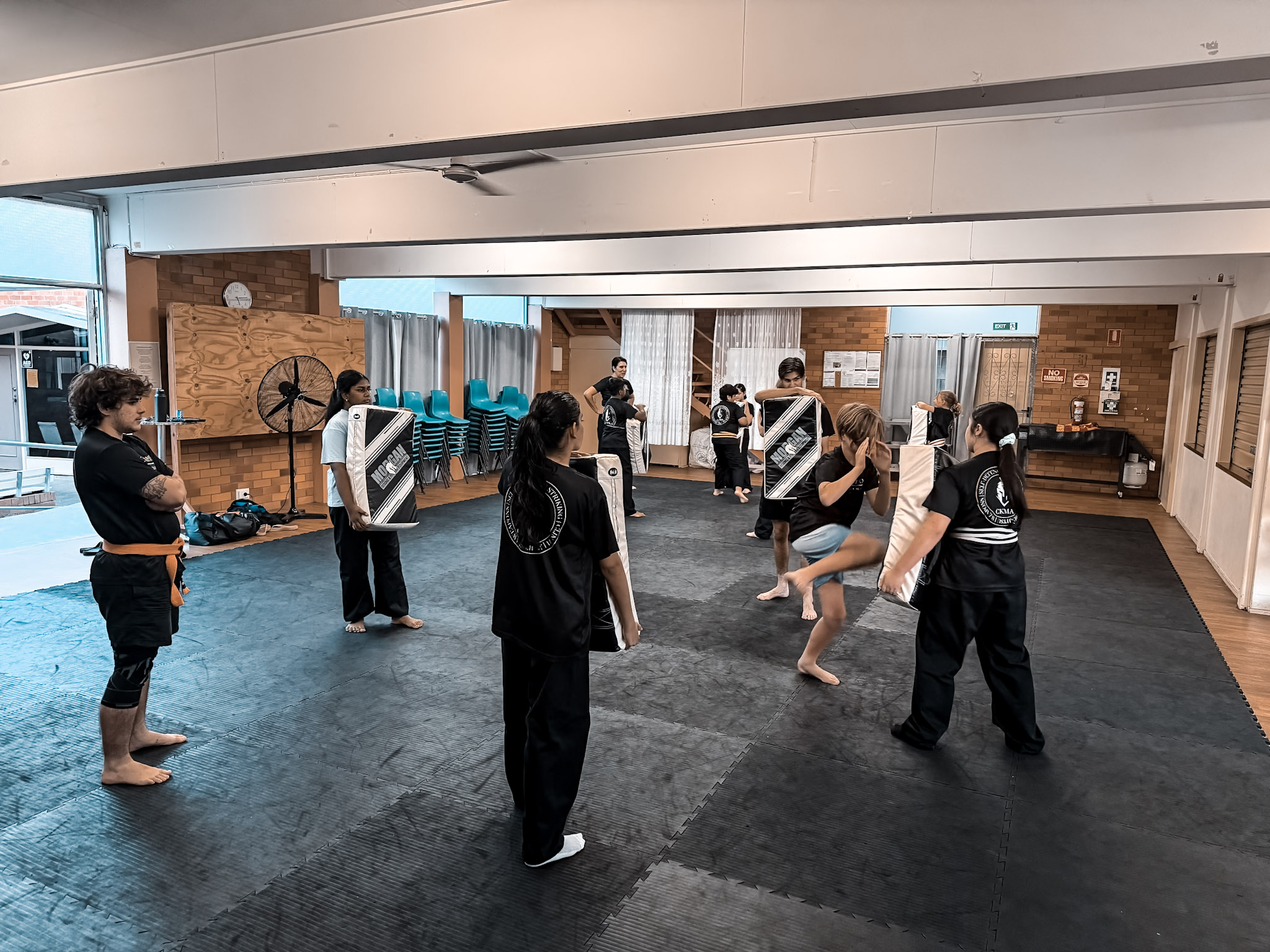
Every session at CKMA opens and closes with structure. Students line up, greet together, and shake hands at the end of class. These are not empty formalities. They are the repeated habits of a disciplined, respectful young person. Many parents notice changes at home within the first month. Better focus. More follow-through. A shift in how their child carries themselves.

Resilience and staying calm when things get hard
One of the most valuable outcomes of consistent youth training is the development of genuine resilience. Students learn to try something difficult, make mistakes, receive coaching, adjust, and keep going. That mental quality is not taught in a single session. It is built through repetition over time. And it carries well beyond the mat into school, sport, and the social pressures of growing up.
What to expect in your child's first class
Your child’s first class is designed to feel settled and manageable. They do not need to know the movements, the terminology, or the class structure before they arrive. As the parent, you are there to watch. Here is what both of you can expect.
Before you arrive
After you book the free intro class, we confirm the time and help you prepare your child for what to expect. Knowing what to wear, what to bring, and roughly what the class looks like removes a significant amount of the pre-session anxiety that many first-timers feel, especially younger or shyer children. Comfortable training clothes and a water bottle are all they need.
When you arrive
One of the CKMA team will meet you at the door, take care of any waivers or paperwork, and help your child know where they are going. Where possible, we pair new students with a more experienced student of a similar age so they have someone to follow without feeling singled out.
During class
Their first class starts on time. The instructor teaches step by step and students train in a controlled, supported environment. There is no expectation that your child will get everything right in their first class. The goal is to feel the environment, try something new, and leave with more confidence than they arrived with.
Before you leave
At the end of class, students line up, the instructor closes the session, and the group greets out. Before you leave, we help you understand the right next step for your child, whether that is the Kids Krav Maga program or the Teen program, and what the first few weeks look like.
Why parents choose CKMA for their children
There are youth martial arts options across Brisbane Southside. Here is what parents consistently find different about CKMA.
Age-appropriate programs with no cross-over between groups
CKMA runs fully separate programs for kids aged 6 to 10 and teens aged 11 to 17. The curriculum, the coaching style, and the class culture are built for each age group specifically, not adapted from a single adult program.
The class runs on time, every time
The kids and teen timetable is built around real family logistics. Classes run on weekday afternoons and finish in time for dinner. When a class runs consistently on time, the routine becomes sustainable. For busy families, that reliability is often the reason training actually sticks.
Skills that transfer beyond the mat
The focus at CKMA is not only on techniques. It is on awareness, calm decision-making, confidence, and respect. These are the qualities that show up at school, in social situations, and in the small daily moments parents are actually watching.
A system your child can grow with
The youth Krav Maga programs are built around long-term development. There is a structured curriculum, clear progression milestones, and grading pathways that keep training purposeful as your child’s ability grows. This is not something they will outgrow in a term.
A coaching culture built on safety and respect, not dominance
CKMA’s values are Service, Growth, Community, and Safety. The goal is a child who is confident without being aggressive and capable without being reckless. That distinction matters to most parents and it is built into how we coach, not just how we market.
No lock-in contracts and a straightforward joining process
Youth memberships include a one-off uniform fee to cover your child’s CKMA training uniform. There are no joining fees and no lock-in contracts.
Which youth program should your child start with?
Kids Krav Maga (Ages 6 to 10)
Designed for this specific age group with coaching that is structured, encouraging, and age-appropriate.
Teen Krav Maga (Ages 11 to 17)
More applied self-defence, situational decision-making, and a framework covering what happens before, during, and after a real-world incident.
FAQ: parents new to Krav Maga
Is Krav Maga safe for children?
Yes. Youth training at CKMA is age-appropriate, structured, and safety-first, especially for children new to martial arts. Children train in a controlled environment with clear coaching standards. There is no uncontrolled sparring for beginners.
My child is shy and lacks confidence. Will they struggle?
Most children who are new to martial arts begin exactly like this. Confidence is not a prerequisite for joining. It is one of the outcomes of staying. The structured environment, consistent coaching, and clear progression milestones give quieter children a safe place to grow at their own pace.
Do kids and teens train together?
No. CKMA runs fully separate programs. Kids Krav Maga is for ages 6 to 10. Teen Krav Maga is for ages 11 to 17. Each program is built around the specific developmental needs of that age group.
Will training make my child aggressive?
No. The goal of youth training at CKMA is the opposite of aggression. Students learn awareness, de-escalation, calm decision-making, and respect. Most parents find their child becomes calmer and more grounded after consistent training, not more combative.
My child has been dealing with bullying. Is this the right program?
It is one of the most common reasons parents enrol their children at CKMA. Training builds the awareness, grounded confidence, and calm capability that makes children less likely to be targeted and better equipped to handle difficult situations when they arise.
Give your child a confident first step.
No experience needed. No pressure. Just a clear first step for your child.
Meet the Krav Maga instructors behind CKMA
Champions Krav Maga Academy was founded by Max McGregor, an Australian Defence Force veteran and 3rd Degree Black Belt and Senior Instructor in Gendai Ryu Krav Maga and Jiu-Jitsu. Max is the Brisbane Representative for the Federation of Israeli Martial Arts (FIMA), holds a 3rd Degree Black Belt in Dennis Survival Ju-Jitsu, a Blue Belt in Brazilian Jiu-Jitsu, and brings over 12 years of Krav Maga and martial arts experience to every class he leads. His training includes time in Israel where he earned his Black Belt in Krav Maga, and he has built CKMA from the ground up since 2022 on the values of Service, Growth, Community, and Safety.
Every CKMA instructor is personally trained and developed by Max under the same coaching standards. That student-to-instructor pathway is one of the clearest signals of what this academy produces. Both coaches were students here first. Both were developed here. And both now teach programs at a standard that Max is personally accountable for.
